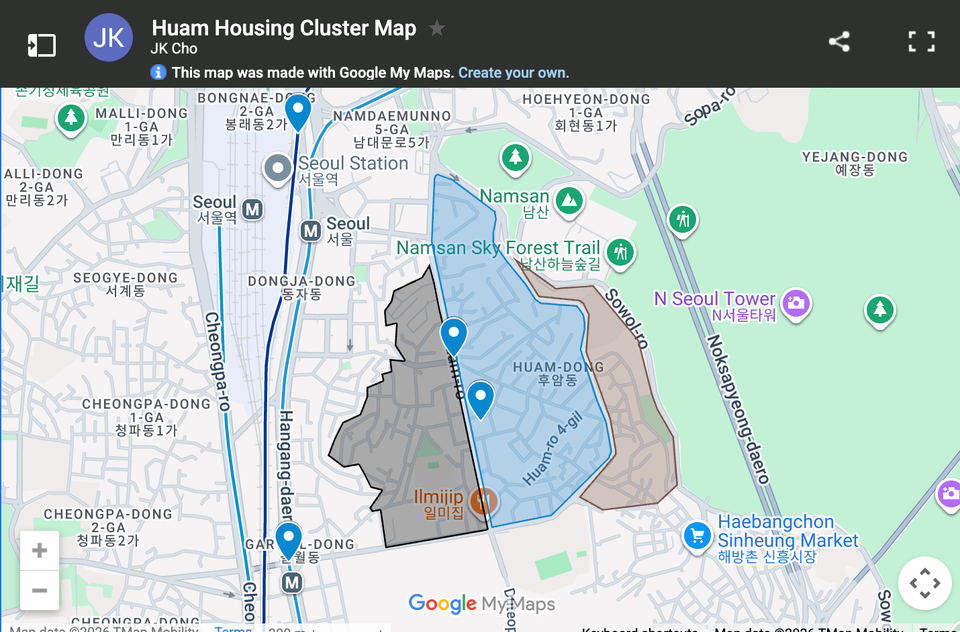
If You Lived Here--Huam (νμ)
These are my housing search notes on Huam.
They keep evolving as I spend more time here. If you're searching here too, feel free to borrow them.
β‘ Huam and HBC look like siblings until you see the density.
HBC isn't actually an administrative neighborhood name. It covers Yongsan 2-ga and spills into the southern edge of Huam, so these aren't perfectly separate places.
Both are old, hilly, low-rise, affordable Yongsan.
But Huam packs around 9,669 households/kmΒ².
That's almost three times my Yongsan median.
Some Yongsan neighborhoods contain huge voids, so I wouldn't compare those numbers too literally. But the distinction is real on foot too.
HBC feels like a small hillside pocket with surprising space.
Huam feels packed. Ordinary Seoul housing, compressed against Namsan.
--
β‘ Huam is currently the cheapest neighborhood in my Yongsan set.
Median effective rent (ER): β©912,500
Median ER/γ‘: β©23,370
Typical jeonse: β©235M
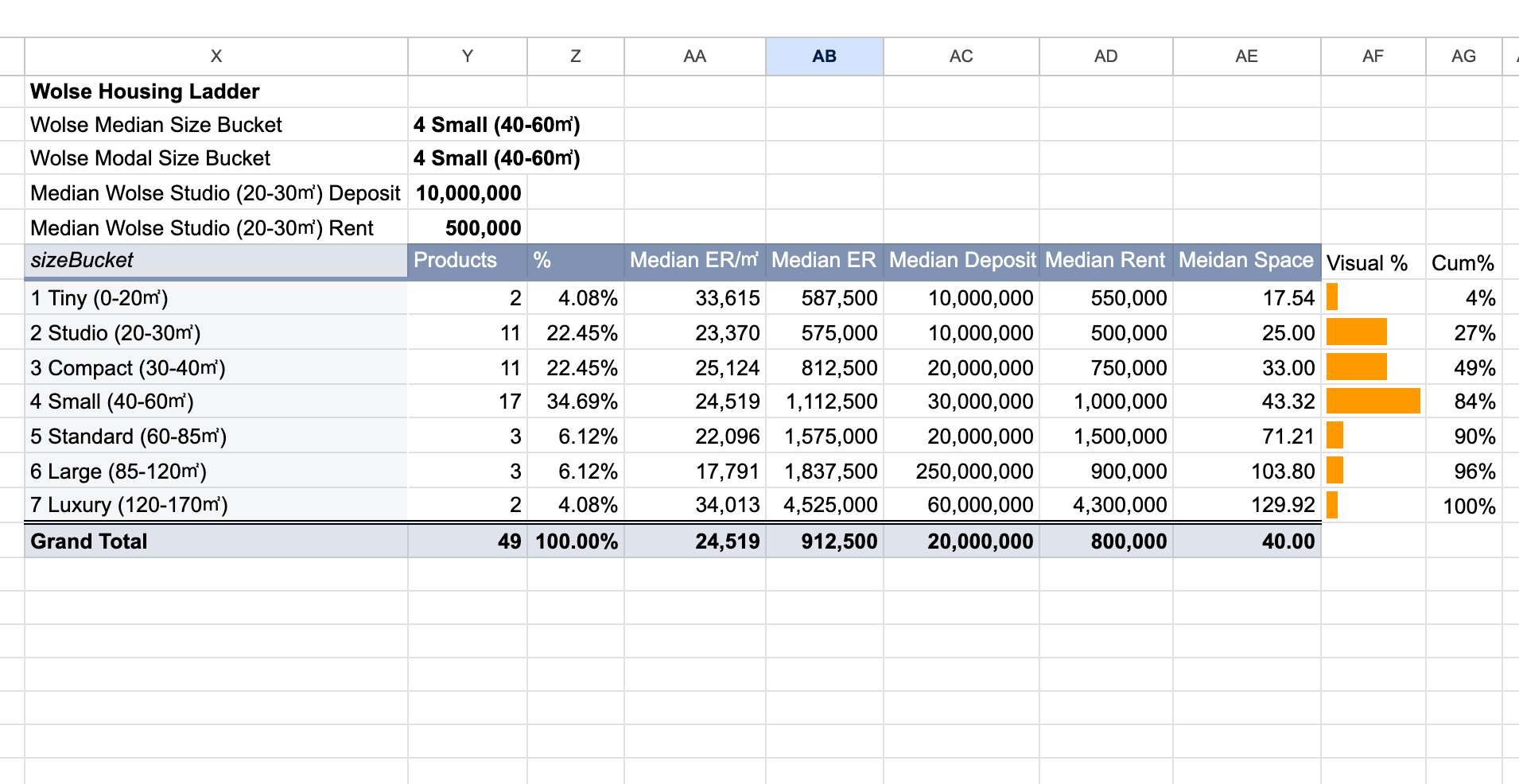
Typical wolse deposit: β©20M
Typical wolse rent: β©800k
That's slightly below even HBC.
And the affordable tail is deep.
100% of the jeonse products I found were below β©700M.
69% of wolse products had deposits below β©50M.
86% had rent below β©1.5M.
So this isn't just a cheap median produced by a few inexpensive units.
Affordable housing is a substantial part of the actual market.

--
β‘ But Huam doesn't give you HBC's spaciousness.
Huam median door: 36γ‘
HBC: 45γ‘
The price difference between them is almost nothing--β©912,500 vs. β©937,500 median ER. But the typical physical proposition is different.
Huam gives you less room, but inside a much larger and denser residential fabric.
That distinction matters more to me than which one is technically β©25,000 cheaper.
--
β‘ The terrain helps explain the compression.
Namsan closes the neighborhood from above.
Toward HBC, the residential fabric squeezes through the uphill corridor between Namsan and the old Garrison edge.
To the west, Seoul Station and the railways form another hard boundary.
Huam doesn't have much room to casually spread.
New development here often doesn't look like Hangangno-style consolidation, where little lots disappear into one large project.
The little lots survive. The buildings get rebuilt more efficiently.
Narrow houses. Compact multi-unit buildings. What Koreans often call micro-houses (νμμ£Όν).
So a lot of ordinary residential life has been fitted into the slopes and little parcels that remain.
--
β‘ Huam is old Seoul housing all the way down.
Median building age: 28 years.
The most common age segment is 31β40 years.
About 77% of the doors I found were either detached/boarding houses or villas.
Apartments were only about 5%.
So like HBC, you're mostly shopping old bones.
But Huam has much more of those bones.
93 estimated doors vs. HBC's 39.


--
β‘ This also looks much more like a local Korean housing ecology than HBC.
The registered foreigner ratio is only 2.76%, compared with HBC's 13.59%.
HBC's foreign population is a visible part of its housing story. Huam seems much more local.
--
β‘ The online inventory is very clean--literal.
93 doors / 97 products / 119 listings.
Packaging ratio: 1.04
Listing inflation: 1.23
Only 1.28 listings per estimated door.
That's the lowest multiplication I've seen in the Yongsan set.
Compare that with Ichon (2.54), Hannam (2.52), or Hangangno (2.24).
So when Huam shows you 119 listings, there isn't a huge hidden machine underneath turning every physical door into several financial products and advertisements. The door mostly stays the door.
--
β‘ Owner-office relationships look pretty sticky.
About 88% of products appeared through only one office--the highest exclusivity rate in my Yongsan set.
At the same time, the Top 5 offices account for about 37% of listings and the Top 10 for 52%.
Add the almost nonexistent financial packaging and relatively little listing inflation, and the whole thing feels hyperlocal.
I keep picturing older owners working with the same budongsan down the street they've known forever.
--
β‘ So I probably wouldn't run Huam primarily from the screen.
The inventory isn't particularly fresh.
Median listing age: 13 days.
Only 10.9% appeared within the previous three days.
This is a place I would leave the platform early and trust legwork more.
--
β‘ Walk the slope, then knock on doors.
Huam is one of those places where 500 meters on a map can hide a lot.
Slope. Bus access. Seoul Station access. Alley width. Parking. Building condition. Sunlight. The feeling of walking home every day.
I'd use the screen to understand the price and product range.
Then I'd go local.
I'd first figure out which little part of Huam I can actually imagine living in.
Then I'd start knocking on the budongsan doors inside those pockets.
Because unlike Itaewon, where listings can be useful gateways into a fragmented market, Huam looks like a place where the local office itself may be the gateway.