3 min read

If You Lived Here--Haebangchon (해방촌)
If You Lived Here--Haebangchon (해방촌)

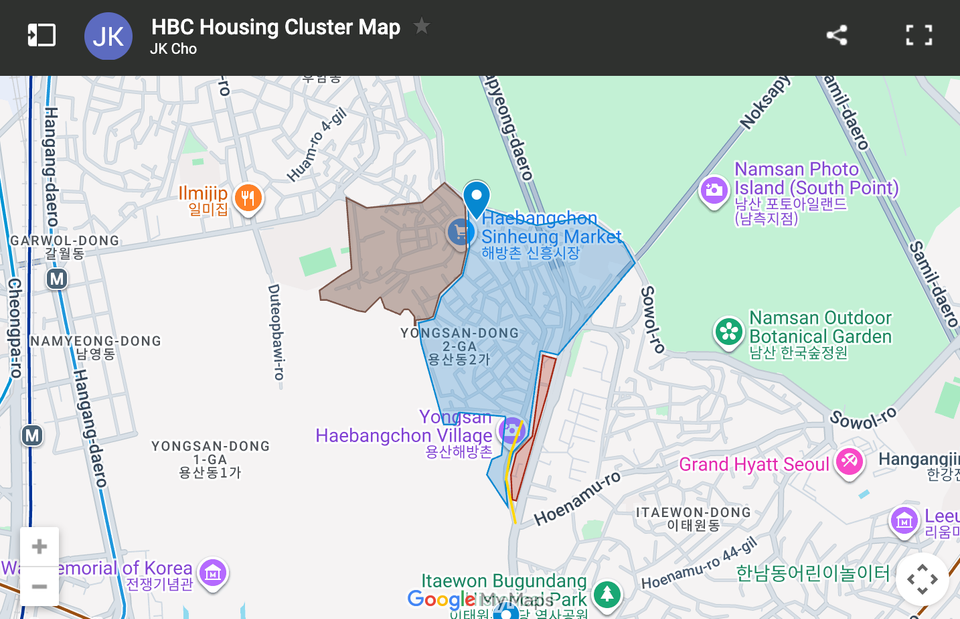
These are my housing search notes on Haebangchon (Yongsan 2-ga).

They keep evolving as I spend more time here. If you're searching here too, feel free to borrow them.


□ HBC looks more distinctive from other Yongsan neighborhoods than I expected. 

For sure different from the premium residential of Hannam, Hangangno, and Ichon. This isn’t just "cheaper Itaewon" either.
The HBC housing DNA is the combination of:
tiny inventory + old ordinary housing + a surprising amount of space for the money.

--

□ HBC is not simply cheap. 

It sits at the bottom of Yongsan's price ladder while still retaining unusually large usable housing.

Huam is marginally cheaper, but HBC gives 45㎡ versus 36㎡ at almost the same median ER.

--

□ I found only 39 estimated doors / 50 products / 72 listings. 

That's an extremely small observable market. 

To put that in perspective:
Itaewon’s got 233 / 293/ 416
Even Huam has 93 / 97 / 119 

--

□ Not just small market. Very little of its housing appears to be circulating.

Only 0.79 doors showed up for every 100 households. That’s the lowest observable inventory rate I've seen so far in Yongsan.

The housing almost looks reluctant to come onto the market.

--

□ Unusually old-school housing bones for central Seoul.

Roughly 72% of the doors I found are villa (다세대) + boarding houses (다가구).

Median building age is 27 years, and the most common age segment is 41+ years. – the oldest among my Yongsan neighborhoods set.

Compared with others, HBC doesn't look like a place where the old housing ecology got heavily replaced by apartments, officetels, and standardized small-unit products.

--

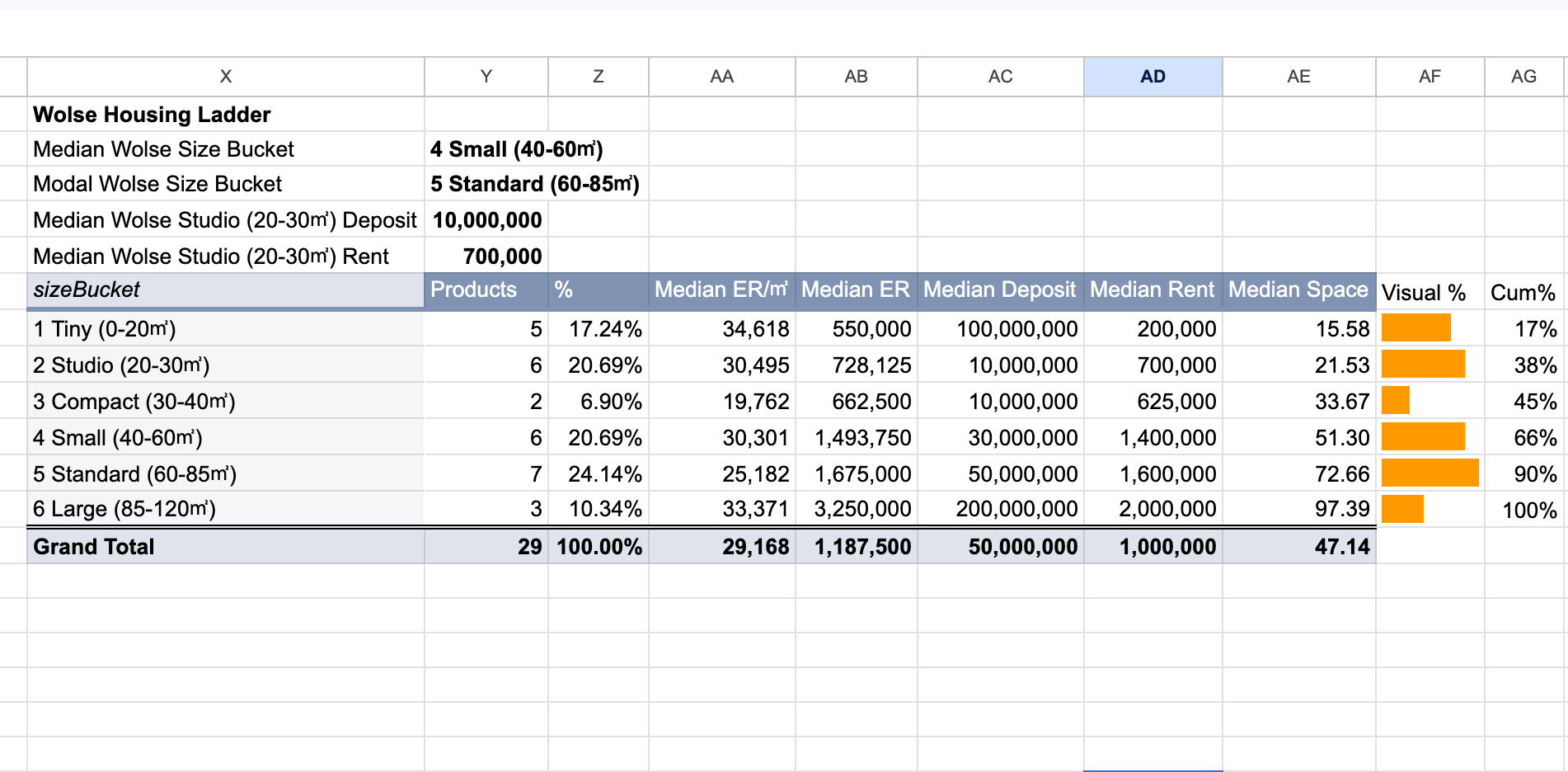
□ The middle-of-the-pack HBC door is surprisingly roomy--45㎡.

A similar price range hood with a foreigner friendly vibe such as Seogyo (Mapo) has 28㎡.

To me, 20-30is tight.
30-40is compact. 
40-50㎡ is breathable. 

--

□ It’s affordable for a different reason from Seogyo.

Median effective rent in HBC seems cheap, similar to the Seogyo level--937,500 vs. 900,000. But you're getting considerably more space than in Seogyo. 

In HBC, much of it is embedded in older villa and boarding houses--odd layouts, stairs, weaker parking, older bathrooms and kitchens, insulation issues, and so on.

You're buying old bones rather than efficient space and comfort.

--

□ HBC has the most concentrated office visibility I've seen in Yongsan so far.

There are 39 estimated doors and 33 offices advertising something here. Yet the Top 5 account for 40.28% of listings and the Top 10 for 59.72%. At the same time, 76% of inferred financial products appeared through only one office.

So raw listings concentrates around a few offices, while most individual offers don't circulate widely across offices.

Makes me wonder if some offices simply have much deeper owner relationships here.

--

□ This doesn't look like a market I'd brute-force on Naver.

Median listing age is 13 days. Only 6.9% of listings were posted within the previous three days.

There isn't much online inventory in the first place, and not much of it was freshly posted.

Add the concentrated office visibility and low product circulation, and choosing which budongsan doors to knock on may matter disproportionately.

Five random budongsan visits may not be equivalent to five well-chosen ones.

--

□ The 13.59% foreigner ratio also reads differently now.

HBC has a substantial registered foreign population, but its housing stock doesn't look particularly "foreigner-productized."

No officetel market. No short-term products at the moment. Mostly ordinary old Korean low-rise housing.

Which makes me wonder if part of HBC's foreign character comes from foreigners learning to inhabit the housing that was already here.

--

□ And then there is the hill.

The housing units are sitting on a steep hillside with weaker subway convenience, difficult vehicle access in places, stairs, alleys.

You get surprisingly central Yongsan geography, Namsan at your back, Itaewon below you. 

HBC may be one of the remaining places in central Yongsan where you can buy space and centrality cheaply precisely because so much of the old physical friction is still intact.

--

□ Go see the neighborhood.

I'd start around the five-way intersection and Shinheung Market.
I'd walk uphill, not just across.
I'd notice how quickly the hill starts bothering me or doesn't.
I'd pay attention to what those older 40–60㎡ villas actually feel like inside.
And I'd probably knock on a few important budongsan doors along the way.