If You Lived Here--Hangangno (νκ°λ‘)
These are my housing search notes on Hangangno.
They keep evolving as I spend more time here. If you're searching here too, feel free to borrow them.
β‘ The most "modern housing market" I've seen so far in Yongsan.
Apartment towers. Officetels. Newer mixed residential products. Defined unit sizes. Relatively standardized layouts.
The dominant housing isn't the old villa (λ€μΈλ) and boarding houses (λ€κ°κ΅¬) ecology you see in HBC or Huam.
Hangangno feels like rebuilt housing products that are easier to compare.
--
β‘ It sits below Ichon and Hannam in price, but clearly above Itaewon, HBC, and Huam.
Median effective rent (ER): β©3.29M
Median ER/γ‘: β©47,766
Typical jeonse: β©1.125B
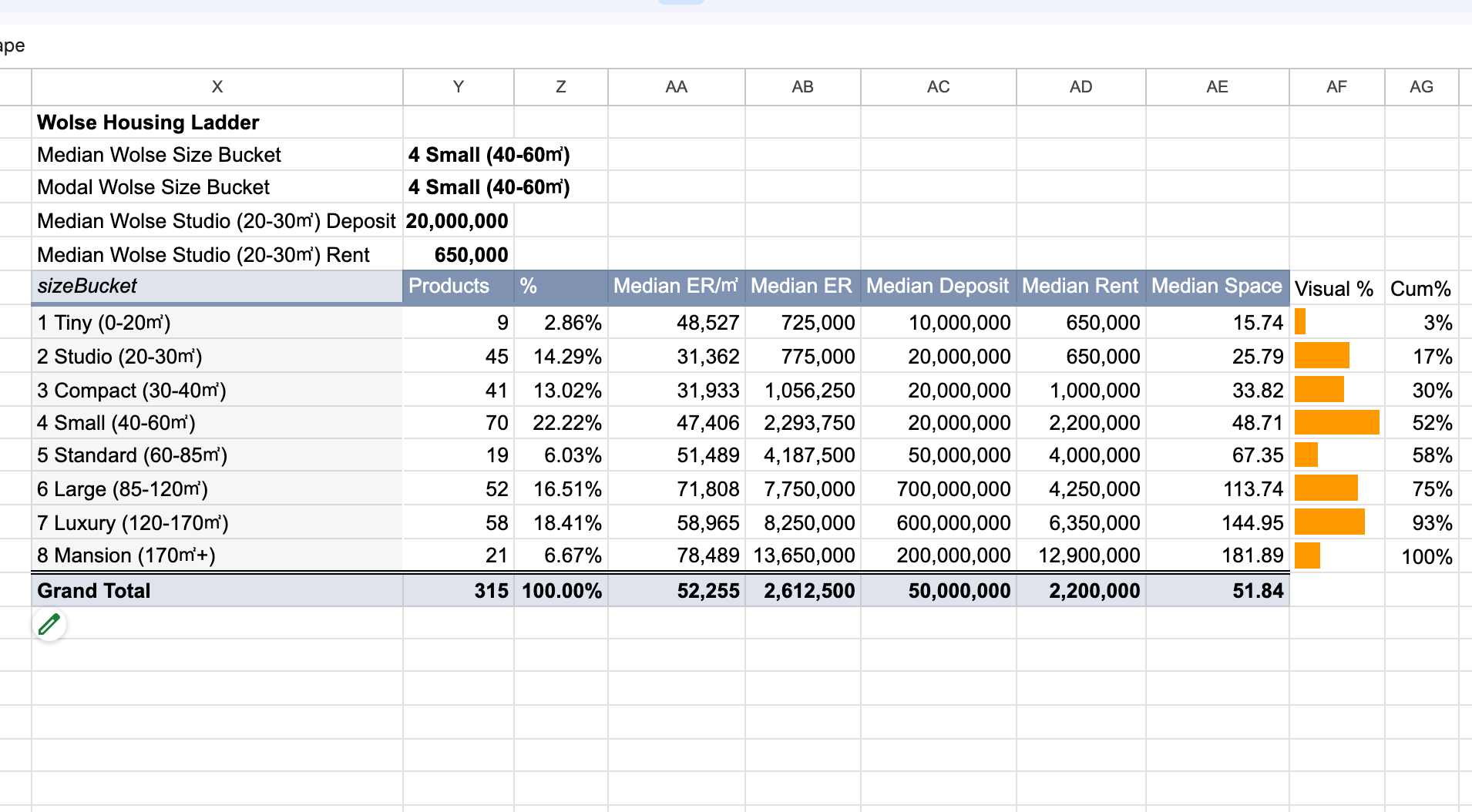
Typical wolse deposit: β©50M
Typical wolse rent: β©2.2M
It feels more like the entry end of premium Yongsan.
--
β‘ Hangangno has a surprisingly clean housing identity.
Unlike Itaewon, where the median compresses several very different housing worlds into one number, a lot of Hangangno seems to gather around a recognizable housing product.
Around 81% of the doors I found were high-rise apartments or officetels.
The median building age was 18 years (the youngest in the Youngsan set), right inside the dominant 11β20 year age band.
There is a thick hump centered roughly around β©50k ER/γ‘.
--
β‘ But size splits into two different ladders.
Wolse gathers more around smaller and medium units, while jeonse leans heavily toward 85β170γ‘ family-sized housing.
So Hangangno doesn't necessarily have one thick middle-sized home. It has a recognizable housing system with different products depending on how you're entering it.
--
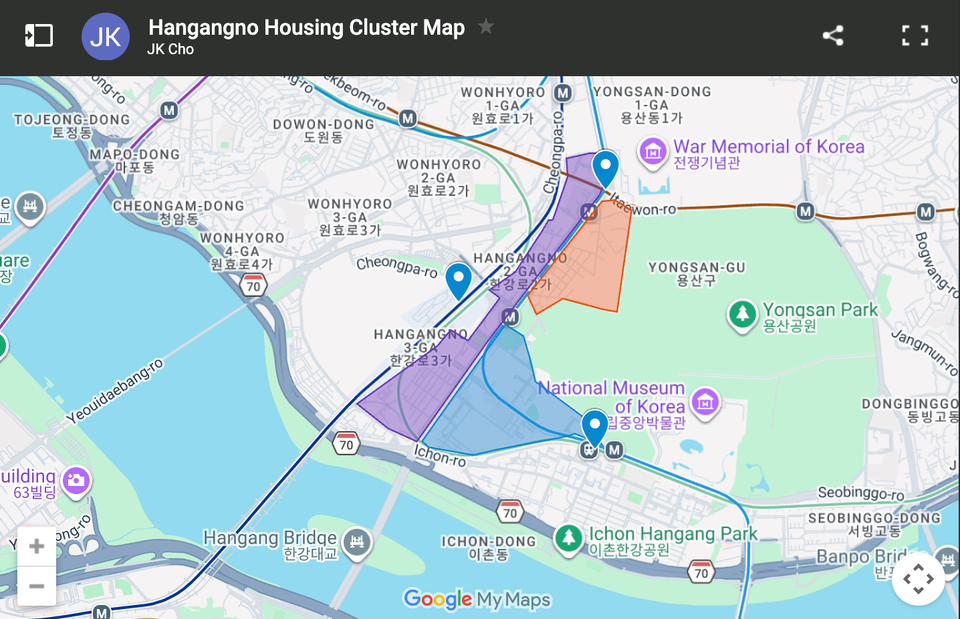
β‘ Hangangnoβs strange bounded triangle may help explain why it went vertical in large clusters.
Rail yards and tracks on one side. The old Garrison boundary on another. The river and major roads around it.
As land inside those hard edges became that valuable, staying small and fragmented probably became harder to justify.
Owners combined their little pieces, and whole chunks went up together as apartments, officetels, and large residential complexes.
Thatβs just my read.
--
β‘ The housing itself makes a defined buybox easier.
Hangangno has recognizable building types, layouts, size bands, and housing patches.
So compared with Itaewon, I suspect many searchers can arrive knowing much more specifically what they want.
A particular layout. Amount of space. Building type. Maybe even a particular complex.
The clean housing identity itself makes a more defined buybox possible.
--
β‘ Hangangno inventory moves.
Median listing age is only 6 days. About 25.2% of listings were posted within the previous 3 days.
That's almost as fresh as Itaewon, and dramatically fresher than HBC, Huam, or Hannam.
Is this fast absorption? Maybe.
It would fit my theory that Hangangno searchers often know what they're waiting for. But offices could also simply be refreshing listings more aggressively.
For now, letβs keep it simple:
the online surface turns over quickly enough that watching fresh inventory matters here.
--
β‘ But a lot of online visibility may not necessarily mean a lot of additional housing.
Hangangno has a 1.64 packaging ratio.
That's the highest in my current Yongsan set.
In other words, one inferred physical door often appears as more than one financial product: jeonse, wolse, wolse in different deposit/rent combos.
Then the listing layer adds another 1.36Γ visibility on top of those products.
So when Naver looks abundant, part of that abundance is real inventory. But part of it is the same physical housing being financially repackaged.
--
β‘ The money around the door seems unusually flexible.
Hangangno has the highest packaging ratio in my Yongsan set: 1.64 products per inferred door.
So the same physical housing often appears as jeonse, wolse, or different deposit/rent combinations.
Rather than: "Sorry, I need exactly β©1.2B to keep my deposit chain intact."
They are saying: "I'm okay with either jeonse or wolse. Let's see what comes."
--
β‘ Budongsans here donβt seem to compete through visibility domination.
Even the Top 10 offices account for only 36% of listings.
That fits my other reads of Hangangno: the housing product is legible, searchers may already know fairly specifically what they're waiting for, and one door can often be worked into several financial configurations.
If that's true, having the owner relationship may matter more than owning the screen.
--
β‘ Get specific, then watch.
I'd walk the main housing patches first.
Understand what changes between Samgakji, Sinyongsan, and the Yongsan Station side.
See one or two representative apartments or officetels so the numbers become physical.
Then I'd tighten the buybox. More like:
"Around 50β60γ‘, this building type, these few pockets, below this ER, with this much deposit available."
Then watch.
Because Hangangno looks like a market where being ready when the fitting product surfaces may matter more than searching harder.